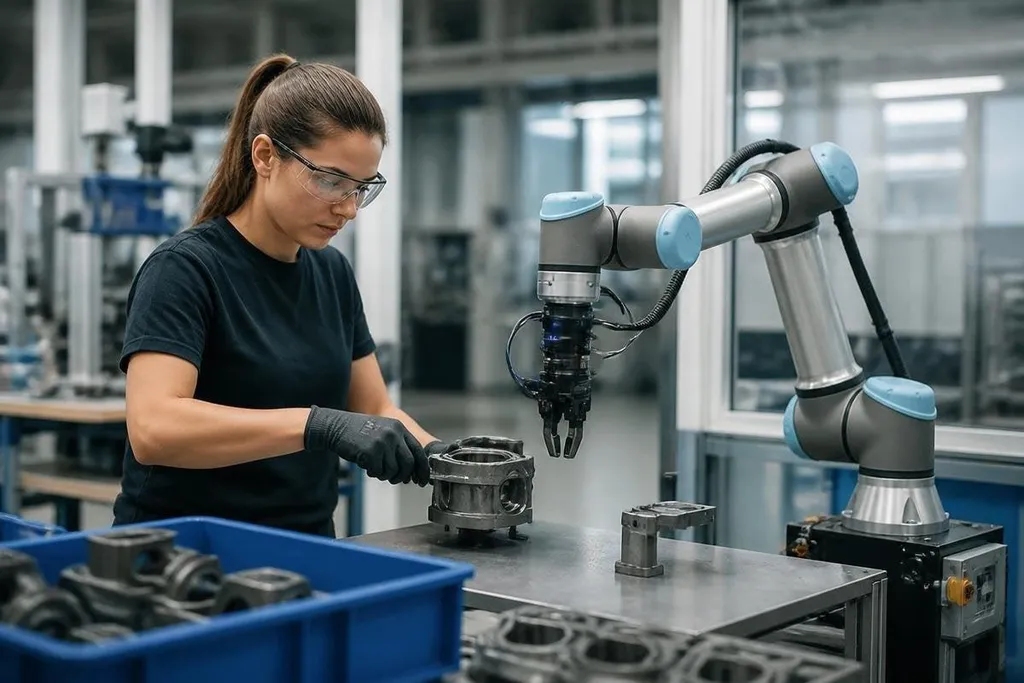
A cobot can lift a part, hold a tool, or check a workpiece beside a person. Its effect on industrial jobs will depend less on the robot arm itself and more on which tasks a factory gives it.
Quick read
- Cobots handle repeatable tasks while people set goals, check results, and deal with faults.
- Jobs may shift toward robot setup, process checks, maintenance, and quality work.
- The open question is how many factories can make these changes pay.
The work changes before the job disappears
A collaborative robot, or cobot, is built to work near people under defined safety limits. It may use force sensing, reduced speed, protective stops, or a marked work area. Those features can let a worker load parts while the arm performs a repeatable motion.
That arrangement changes the work in small steps. A person may place a component in a fixture, press a start control, and check the finished part while the cobot handles screwdriving or machine tending. The job still needs a person, but the person spends less time repeating one motion.
This matters most where a task is tiring, awkward, or hard to staff.
The cobot can repeat the same path for hours, while the worker moves between checks, material supply, and problem-solving. The arm does not understand the whole production line, so someone still has to spot a damaged part or a tool that has started to wear.
New work around the robot
Factories need people who can set up the arm, teach its path, load the correct tool, and check that it works safely beside staff. A technician may also adjust gripper pressure, change a fixture, or diagnose a sensor fault.
Those duties can sit inside an existing job. A machine operator might learn to change a cobot program through a tablet instead of waiting for a controls engineer. A maintenance worker might add robot checks to their normal inspection route. The exact change depends on the factory’s process and the level of training it pays for.
Robot programming also becomes more practical when workers can guide an arm by hand or select tested motion blocks. That can reduce the amount of code needed for a small task, though it does not remove the need to check speed, force, reach, and restart behavior.
The job question needs more than a claim that cobots help workers. Robot24.com can connect a company’s statement to the robot, task, site, and date, giving you a way to judge if a new role replaces lifting, adds monitoring, or leaves the old work in place.
Where the limits show up
Cobots work best when parts arrive in a steady position and the task follows a repeatable pattern. They are a weaker fit when parts vary widely, surfaces are hard to detect, or the arm must move quickly across a busy space.
Safety rules also shape the work. The cobot may slow down when a person enters its working area. That protects the person, but it can cut output if staff and robot paths cross often. A factory may need a new fixture, a fence, a scanner, or a different layout before the task works well.
Training is another limit. A worker who receives a robot without time to learn its controls may spend more effort clearing stops than doing useful production work. A sound plan gives people time to learn the system, report faults, and suggest changes to the task.
The job count is hard to predict without factory data. Higher output from a cobot can support more orders, which can preserve jobs in one site. The same task may reduce labor needs in another site. Claims about total job losses or gains need a named company, process, and time period.
A practical check before adoption
Use this list when reviewing a cobot plan for one production task:
- Name the task: write down the motion, part, tool, cycle time, and handoff point.
- Check the worker’s role: decide who loads parts, clears faults, checks quality, and stops the cell.
- Test the variation: run parts with normal changes in size, position, finish, and packaging.
- Set training time: give operators practice with setup, recovery, safety stops, and tool changes.
- Measure the full cell: include fixtures, sensors, software, maintenance, and idle time in the cost.
- Review after launch: compare the planned task with real stops, errors, injuries, and output.
I expect cobots to change industrial jobs first by removing pieces of work, not whole job titles. That shift can make a role safer and less repetitive, but only if the factory gives workers control of the new process and time to learn it.
The useful test is on the factory floor: which task does the cobot take, who handles the exceptions, and what happens during the first month?